X-Ray Absorption Spectroscopy

Products
Fault Isolation
3D X-ray Microscopes
Contact Sales
Products
X-Ray Absorption Spectroscopy
Fault Isolation
3D X-ray Microscopes
Contact Sales
QuantumLeap-V210
____________
XAS Spectroscopy System
First laboratory XAS with low Z capabilities and microspot analysis
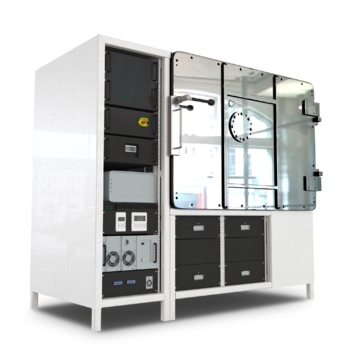
Key Advantages:
- Only laboratory XAS system with synchrotron-like performance
XANES at 0.7 eV and EXAFS within seconds or minutes - 1.7 keV to 10 keV, enabling low atomic number element analysis
Down to 1.7 keV for phosphorus and sulfur analysis within the vacuum enclosure - Maximum MicroXAS at 100 micron spot size
Motorized stage enables XAS mapping at 100 µm over a sample for microXANES and microEXAFS
________________________
Synchrotron-like Performance in a Laboratory XAS System
X-ray absorption spectroscopy (XAS) generates the most publications of any synchrotron approach. Because of the technique’s popularity, XAS beamtime can be challenging to acquire, sometimes requiring lengthy proposal submission and evaluation periods. The competitive nature of oversubscribed beamlines mean that even highly meritorious projects can be rejected. Sigray developed the QuantumLeap products to provide easy access to synchrotron-like XAS performance within your own laboratory,
making it possible to complete research that would otherwise not be feasible, including studies involving many samples or complex in-situ experiments.
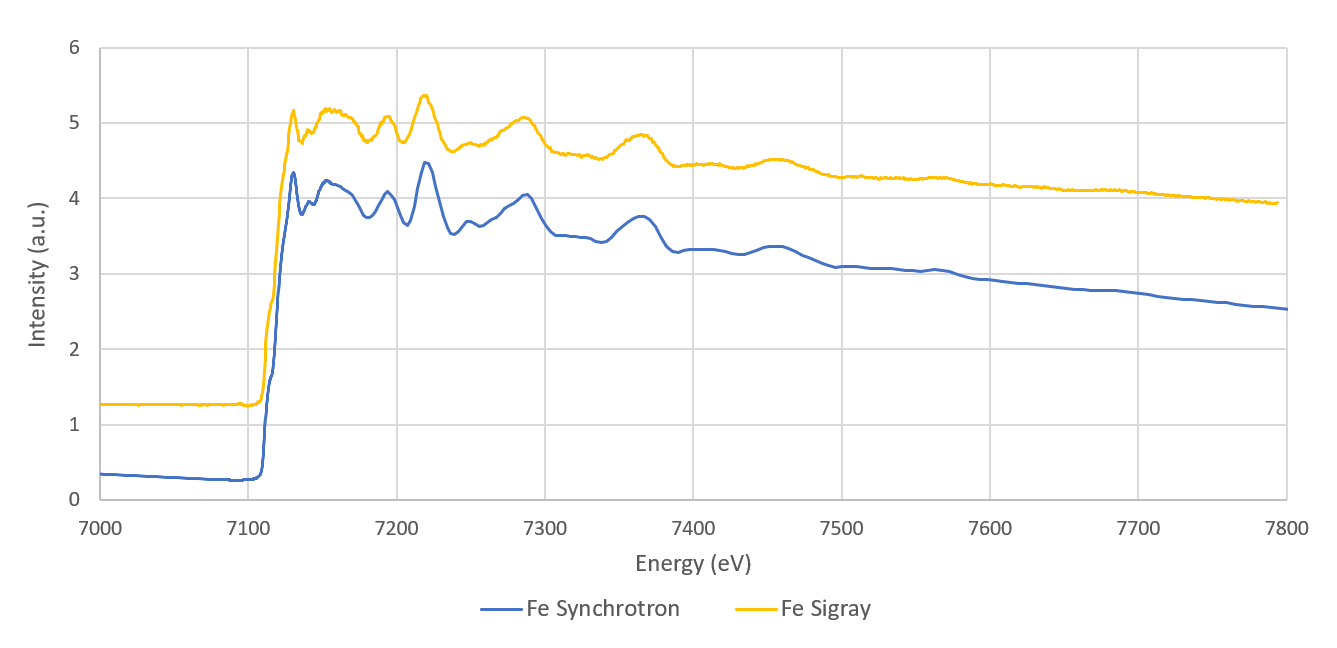
EXAFS spectrum of an iron foil compared to synchrotron data
________________________
Low Atomic Number (Z) Capabilities
The QuantumLeap-V210 is fully enclosed within a vacuum enclosure capable of reaching evacuated environments reaching as low as 10⁻⁵ Torr. The system also incorporates a load-lock chamber for exchanging samples without breaking vacuum. This vacuum environment enables XAS measurements at energies as low as 1.7 keV, allowing for the analysis of important light elements with atomic numbers of Z=15 (phosphorus) and Z=16 (sulfur).
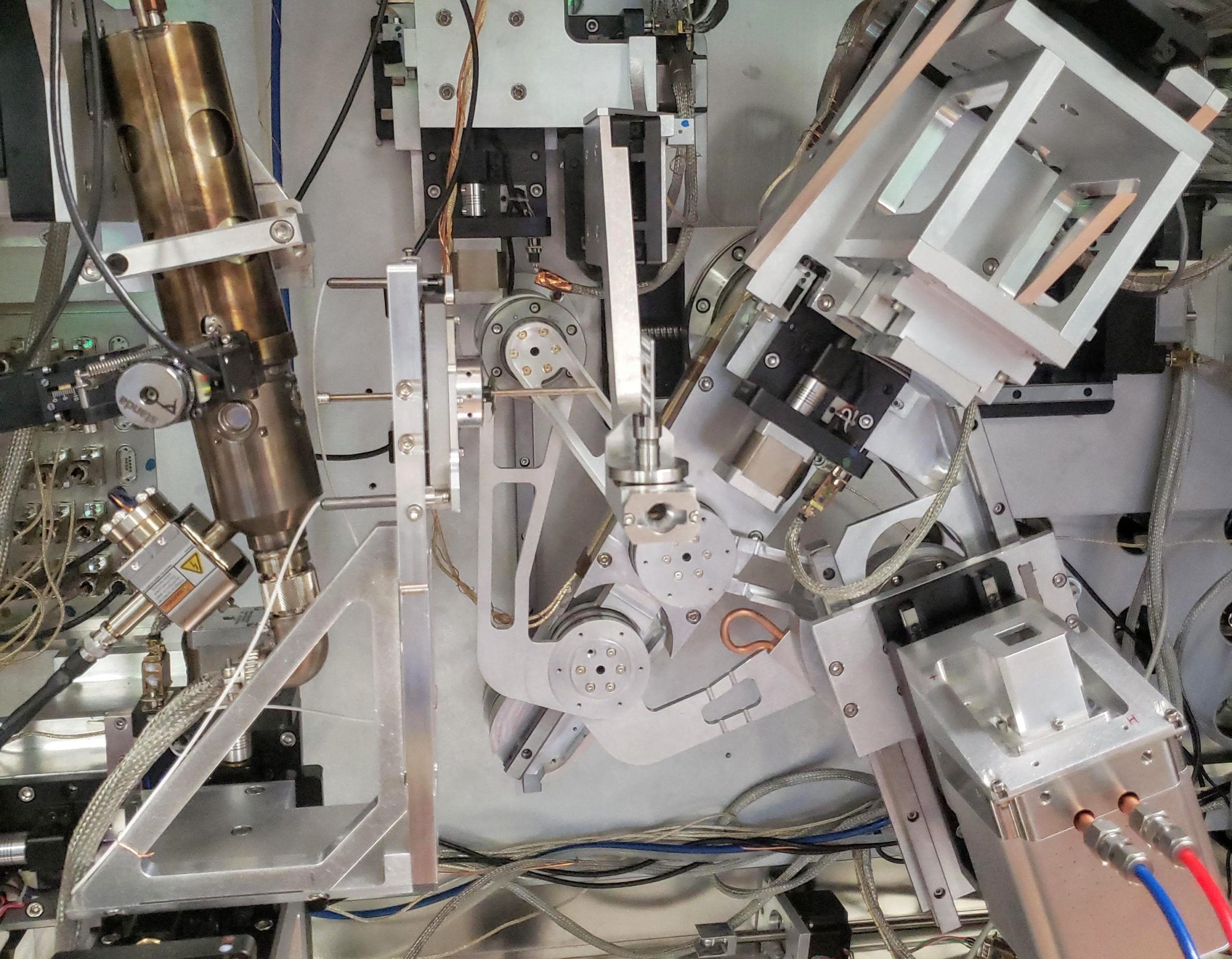
Components of the QuantumLeap-V210 is entirely enclosed within a vacuum chamber.
________________________
MicroXAS at a 100 µm spot size
The QuantumLeap-V210 uses a focusing x-ray optic to direct x-rays onto a small spot on the sample. The small spot size enables high-resolution chemical microscopy, allowing chemical information to be mapped with XANES and/or EXAFS across a heterogeneous sample. Additionally, the small spot size significantly reduces the difficulty of sample preparation. In contrast, large-spot XAS systems with millimeter-scale spot sizes require a high degree of sample uniformity, which can be challenging to achieve.
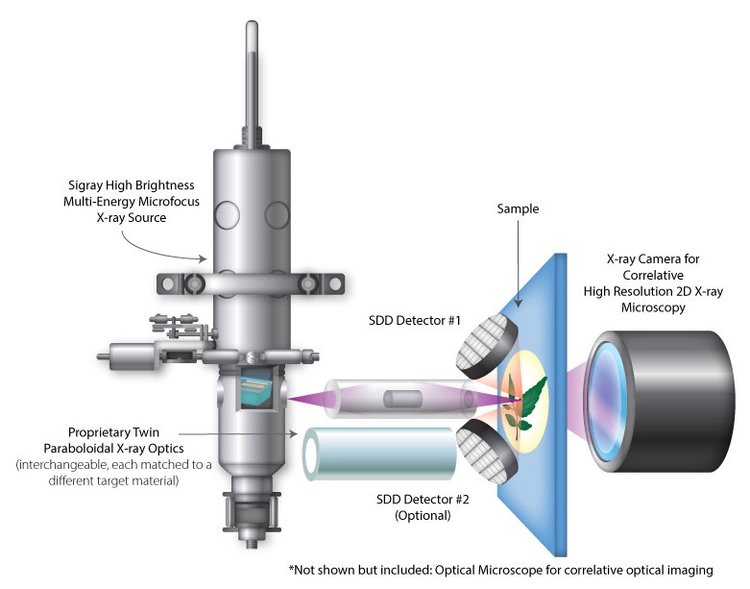
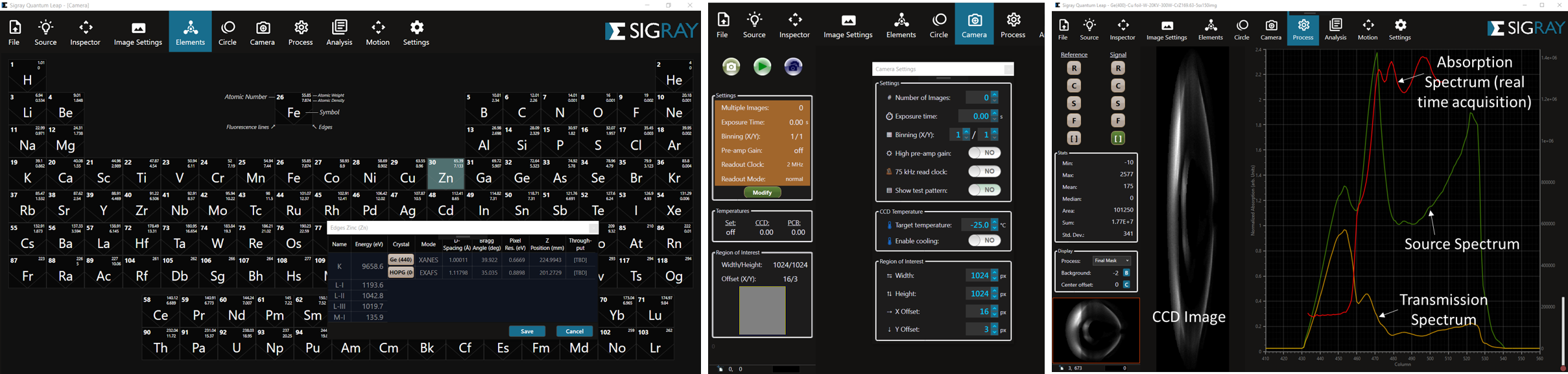
Patented QuantumLeap-V210 acquisition scheme. A focusing x-ray optic directs x-rays onto the sample. A downstream crystal separates the transmitted x-rays by wavelengths into different positions on the spatially resolving detector. The resulting “image” by the detector is the XAS spectrum.
System Features
- Patented high brightness x-ray source with multiple targets, enabling high throughput in the laboratory and acquisition of the full range of elements
- Capillary x-ray optics for achieving a small focal spot (100 µm diameter) at the sample
- Vacuum enclosure that achieves down to <10^-5 Torr for obtaining chemical information on low-Z elements
- Intuitive software for acquisition and analysis. Can output data in CVS files to be read by software such as Athena and Artemis
________________________
Patented Multi-Target Ultrahigh Brightness X-ray Source
The QuantumLeap’s x-ray source features a patented design in which multiple target materials are in optimal thermal contact with diamond, which has excellent thermal conductivity properties. The rapid cooling of diamond enables higher power loading on the x-ray source, producing an intense beams of x-rays. Another key feature of the x-ray source is its motorized multi-material x-ray target, which allows software selection between different x-ray target material. This is important for XAS acquisition because switching between target materials helps avoid strong characteristic x-ray energies that would otherwise contaminate the results.
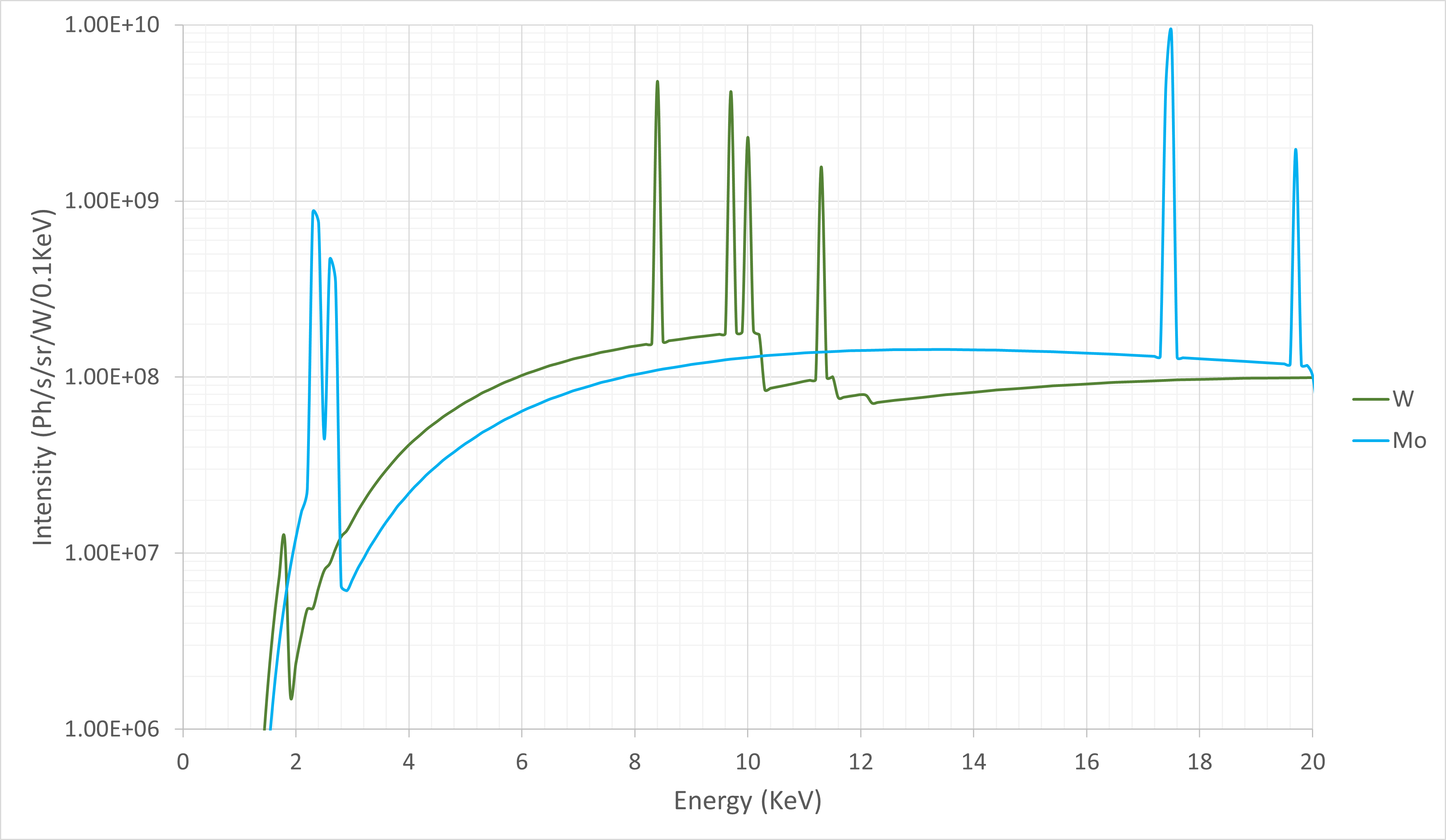
Achieving a smooth spectrum for XAS: Mo (blue) has characteristic x-ray lines around 2 to 3 keV and 17.4 keV, while W (green) has characteristic energies in the 7 to 12 keV range. By selecting target materials, characteristic lines can be avoided so that a smooth spectrum of energies is acquired for a full range between 4.5 to 25 keV.
________________________
Mirror Lens: Capillary X-ray Optics
QuantumLeap-V210 is the only commercially available micro-XAS system. Sigray is recognized as a leading manufacturer of x-ray optics and is a key supplier to synchrotron groups worldwide. The QuantumLeap-V210’s design features x-ray optics that efficiently relay x-rays from the source to the sample without chromatic aberrations. The small focused spot on the sample offers advantages such as simplified sample preparation and the ability to analyze heterogeneous samples at high resolution.
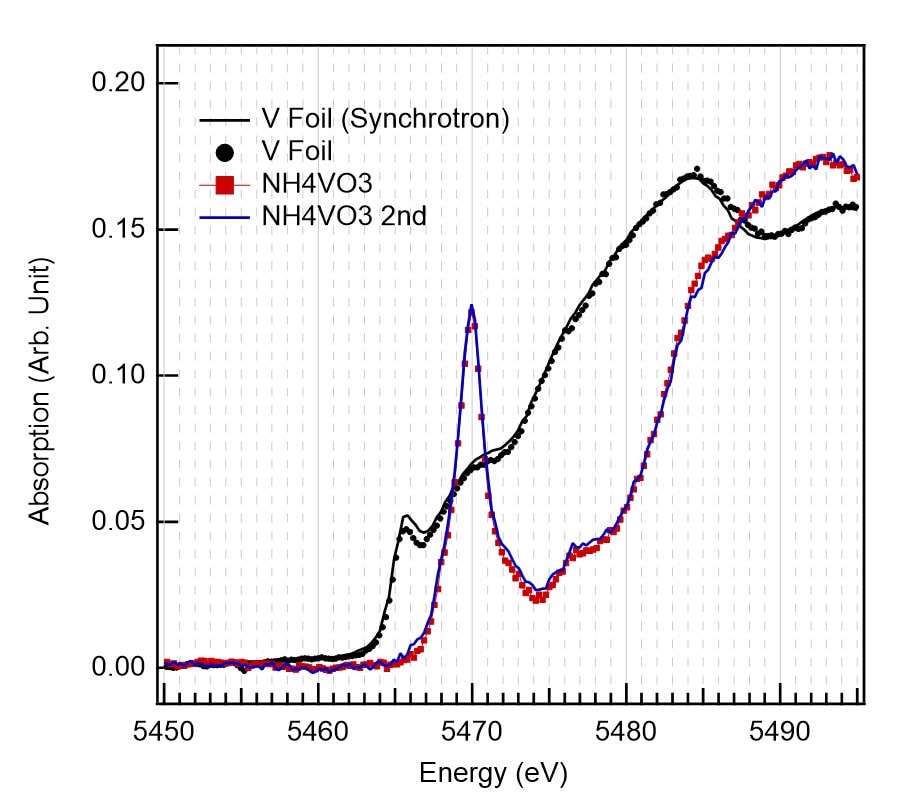
Two spatially different points (blue line and red squares) on a metavanadate (NH4VO3) were taken on the sample to confirm sample uniformity. Also shown are a reference vanadium foil (black dots from QuantumLeap, black line from synchrotron)
_______________
Vacuum Enclosure
QuantumLeap-V210 is entirely enclosed in large vacuum chamber capable of reaching environments as low as 10⁻⁵ Torr. The design is critical for enabling XAS of low atomic number elements such as phosphorus and sulfur. This capability is not available even at most synchrotron XAS beamlines due to the complexity of high vacuum instrumentation.
_______
Software
QuantumLeap features an intuitive GUI for acquiring data, including the capability to set up recipe-based scans for point-by-point mapping or for multiple samples (a sample holder for up to 16 samples of 3″ diameters is provided). Data can be output as CSV files that can be easily read into analytical software, including Athena and Artemis.
Analysis of chemistry in a Co-Cu catalyst sample and measurement of a reference Co foil. Note high resolution features such as pre-edges can be clearly seen.
Applications
_______
Catalysts
Catalysts, which are used to speed up chemical reactions, are estimated to be involved in 90% of all commercially produced chemical products and represent a global market worth more than $30 billion. They are utilizied in a vast array of applications, including polymers, food science, petroleum, energy processing, and fine chemicals. Synchrotron-based XAS has become the method of choice for developing novel catalysts and linking structural motifs with catalytic properties. QuantumLeap provides convenient in-laboratory access to these capabilities without requiring the time and expense required to acquire synchrotron beamtime.
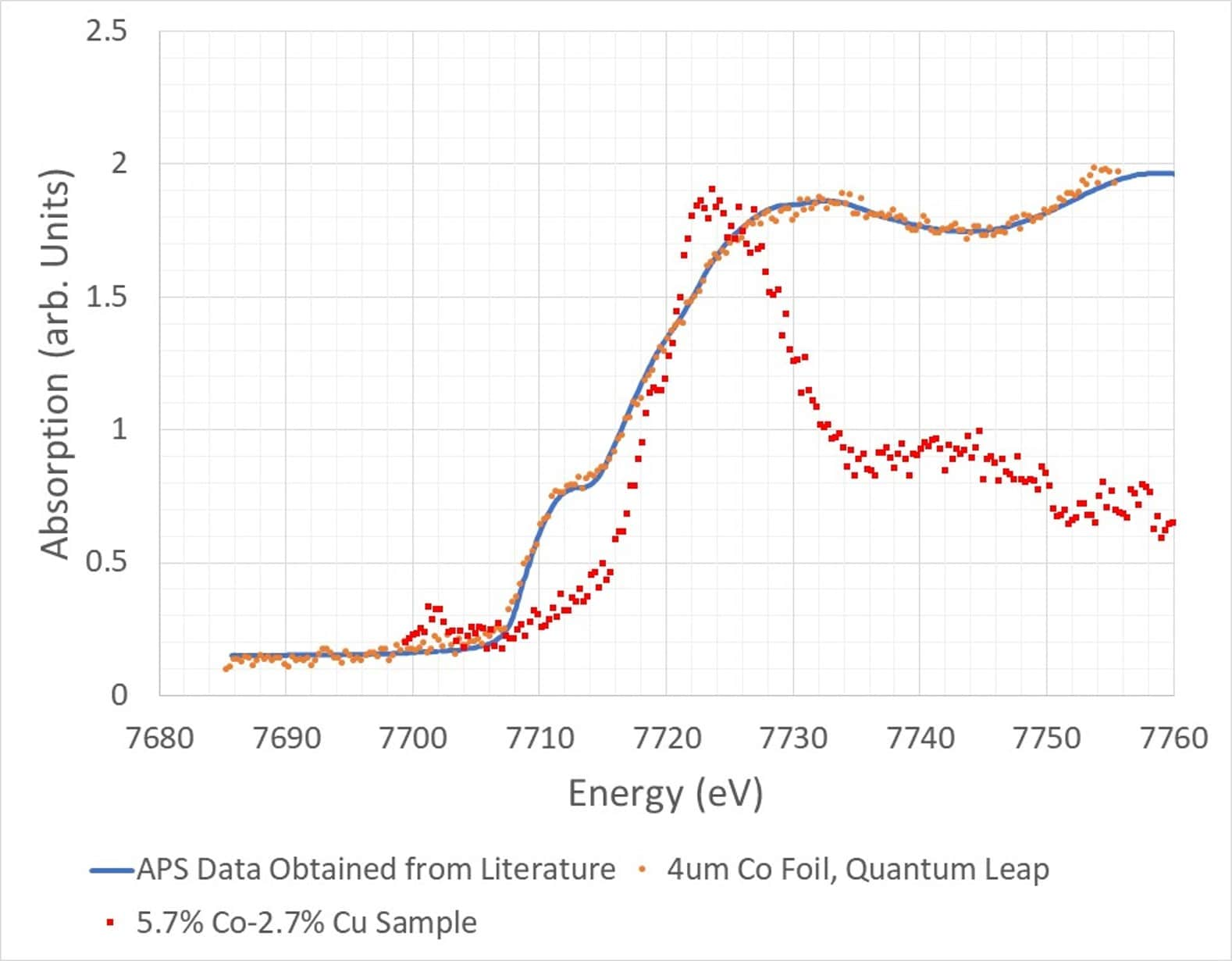
Analysis of chemistry in a Co-Cu catalyst sample and measurement of a reference Co foil. Note high resolution features such as pre-edges can be clearly seen.
___________________
Batteries and Fuel Cells
A large number of potential electrode hosts for Li+ are being explored in lithium ion batteries (LIBs), including different material compositions and various structures ranging from micro-to nanosized. XAS is commonly used to characterize the structural and electronic properties of electrodes to better understand the electrochemical mechanisms governing a battery’s chemistry. Sigray’s QuantumLeap not only enables ex-situ determination of electrocatalyst chemistry, but is also designed with baffles and feedthroughs for optional in-situ cells to study changes in-operando. Furthermore, the vacuum enclosure of the QuantumLeap-V210 permits for the analysis of emerging high-energy-density battery concepts, such as Li-S batteries, by providing access to sulfur chemistry.
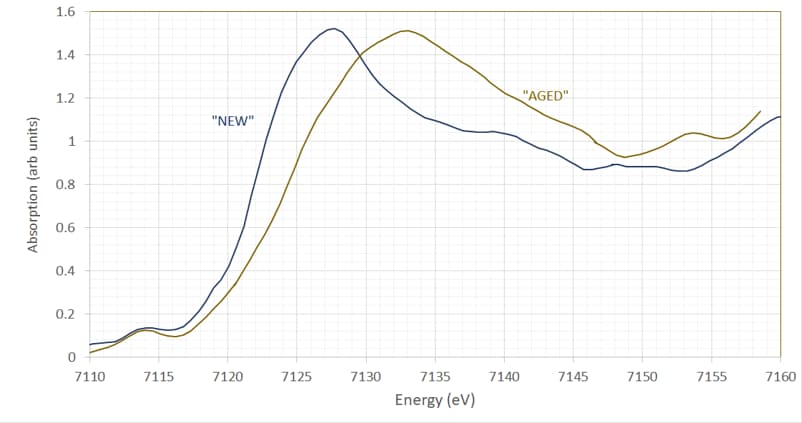
XANES spectrum of a new versus aged lithium ion battery cathode, demonstrating chemical changes
________________________
Nanoparticles and Nanotubes
The electric, magnetic, and catalytic properties of nanoparticles differ significantly from those of the same materials in bulk phase. These properties depend on the nanoparticle’s size and shape. Nanoparticles ranging from 1 to 5nm in size are difficult to characterize using conventional laboratory techniques such as XRD and TEM. XAS provides information on atomic distances, the average size of particles smaller than 2nm, and even their shape.
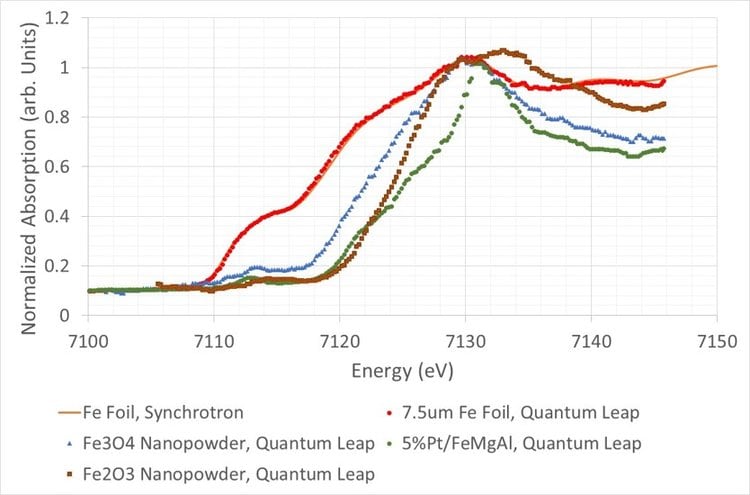
XANES spectrum of a new versus aged lithium ion battery cathode, demonstrating chemical changes
Technical Specifications of the QuantumLeap-V210
|
|
Parameter |
Specification |
|
|---|---|---|---|
|
Overall |
|
1.7 to 10 keV |
|
|
XAS Acquisition |
Transmission mode |
||
|
Energy Resolution |
0.7 eV in XANES |
||
|
Beam Path |
Enclosed in vacuum |
||
|
Focus at Sample |
100 μm diameter spot |
||
|
Source |
Type |
Sigray patented ultrahigh brightness sealed microfocus source |
|
|
Target(s) |
W and Mo standard. |
||
|
Power | Voltage
|
300W | 20-50 kVp |
||
|
X-ray Optic |
Type |
Sigray proprietary double paraboloidal x-ray mirror lens |
|
|
Transmission Efficiency |
~80% |
||
|
Magnification |
1:1 magnification |
||
|
Interior Coating |
Platinum for increasing collection efficiency of optic. |
||
|
X-ray Crystals |
Type |
HAPG/HOPG |
|
|
X-ray Detector |
Type |
Spatially resolving (pixelated detector) |
|
|
Dimensions |
Footprint
|
42" W x 95" H x 75" D |
|
|
Additional Capabilities |
Multiple Sample Holder |
Holds up to 16 samples of ~3mm diameter each |