Products & Technologies

Products & Services
Contact
Products & Services
Products & Technologies
Services
Resources
Contact

Stay updated on our content.
Scaling Next-Generation 3D NAND with High-Precision Selective Removal
September 24, 2026
By Sumit Agarwal, Ph.D.
AI systems are creating an explosion of data. Agentic and physical AI are accelerating this trend as autonomous systems continuously generate and process interactions, environmental inputs and sensor information. This expanding data footprint is driving demand for high-capacity memory that stores more data in less space at lower cost.
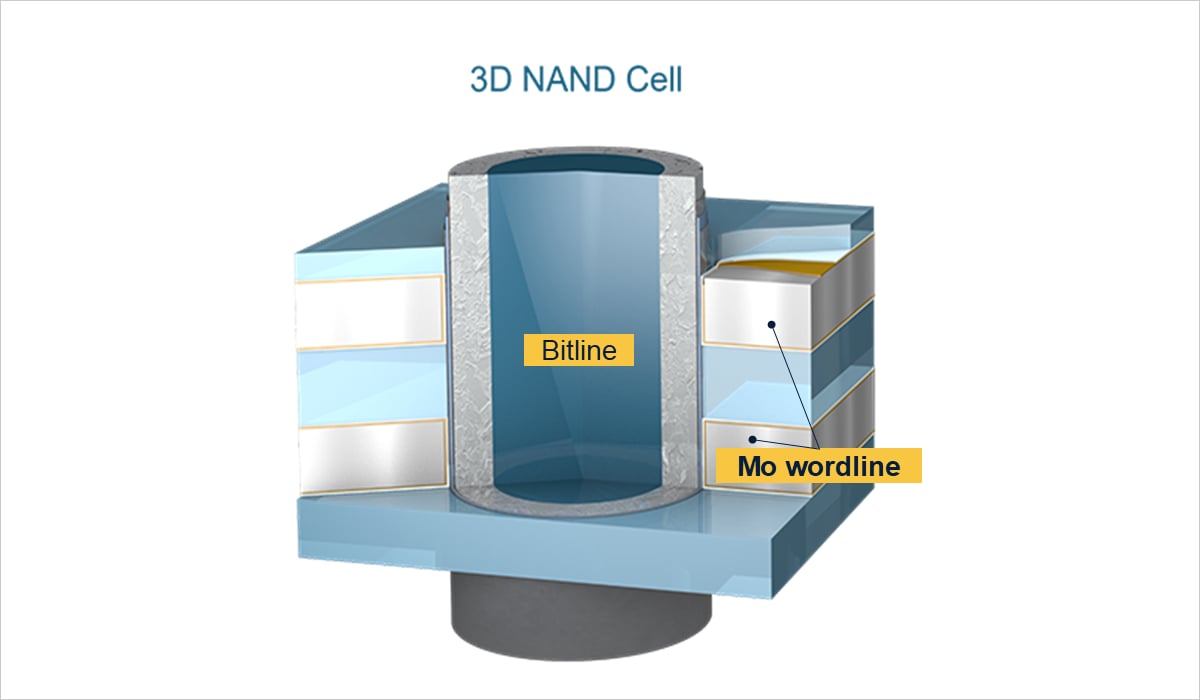
AI systems rely on DRAM, including DDR and HBM, for fast access to the compute-critical data that drives performance. Meanwhile, NAND provides a complementary solution for storing vast amounts of “cold,” less-active data. 3D NAND significantly boosts storage density over standard NAND—without increasing chip size—by holding up to four bits per cell and stacking memory cells in hundreds of vertical layers.

Within these structures, molybdenum (moly) wordlines act as electrical gates that control individual memory cells during data storage and retrieval. As AI adoption accelerates, chipmakers are building taller, more complex 3D NAND structures to deliver the capacity required for data-intensive computing. This demands unprecedented precision in forming these critical wordlines. With Selectra™ Mo Etch, Applied brings its leadership in selective material processing to one of advanced 3D NAND's toughest challenges.
Forming 3D NAND Wordlines with Atomic Precision
Forming the wordlines begins with a moly deposition that coats the exposed surfaces inside a deep, narrow vertical slit and fills the horizontal wordline cavities. The deposited moly also extends into the slit, electrically connecting adjacent wordlines. This excess material must be selectively removed and recessed to separate the individual wordlines so each can function independently.
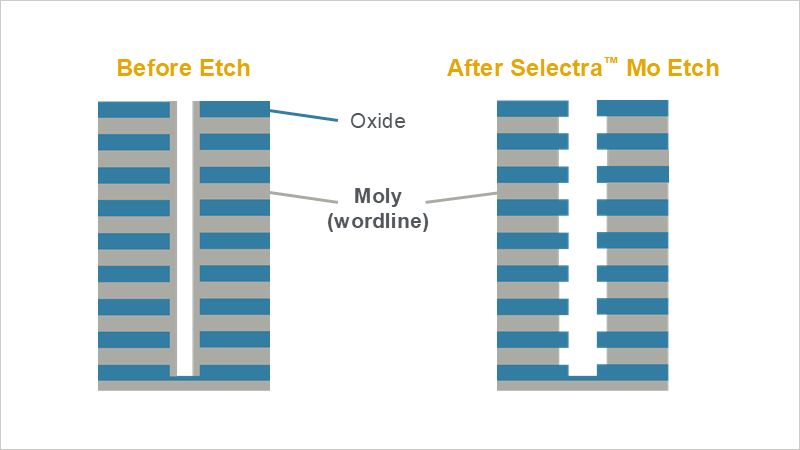
The process must also recess the moly very precisely within every cavity. Too little removal can leave residual moly in the slit, creating leakage paths or electrical shorts between neighboring wordlines. Too much removal can shrink the active wordline structure, reducing electrostatic control over the memory cell. Achieving a uniform recess from top to bottom of the stack is therefore critical to achieving superior device performance and yield.
Historically, chipmakers have relied on liquid-based wet etch as the industry standard approach for this step. But as 3D NAND structures become taller and narrower, liquids struggle to penetrate to the bottom of these deep features. This often results in excessive moly removal at the top and insufficient removal at the bottom.
A New Approach to Selective Removal for Advanced 3D Structures
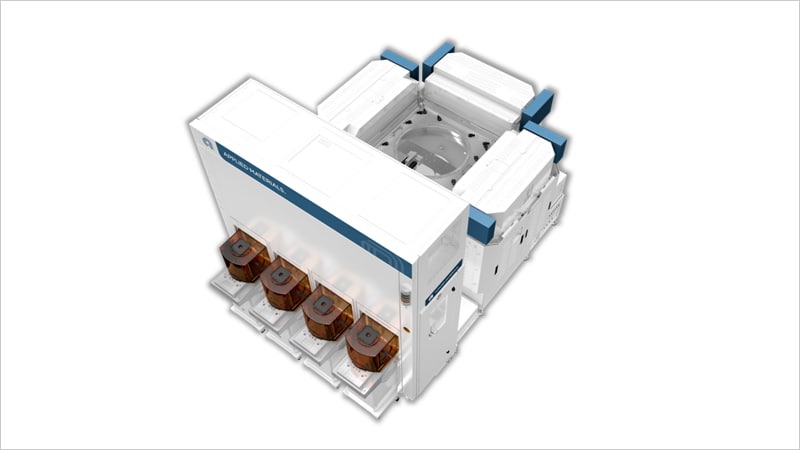
Selectra Mo Etch takes a fundamentally different approach with gas-based selective removal. Its chemistry is engineered to remove moly with high precision while preserving surrounding materials. Compared to liquid chemistry, gases move more effectively through high-aspect-ratio structures. This enables consistent wordline separation from the top to the bottom of the stack.
By replacing wet etch with gas-based selective removal, Selectra Mo establishes a new market segment for Applied’s industry-leading selective removal technology. It also exemplifies how Applied’s materials engineering capabilities can overcome critical scaling challenges and extend the roadmap for 3D NAND.
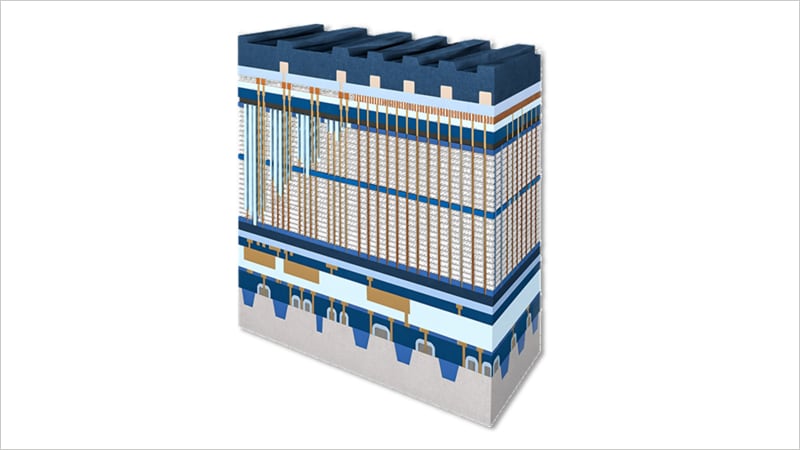
The metal removal capabilities that underpin Selectra Mo Etch are extendible beyond moly and well suited for emerging inflections in advanced DRAM, the performance-critical memory powering AI systems. While 3D NAND scaling has historically centered on dielectric materials engineering, new DRAM architectures such as 4F² and 3D DRAM, along with foundry-logic scaling, are driving greater demand for advanced conductor and metal solutions. These shifts create new opportunities to extend Selectra technology as chipmakers increasingly adopt complex 3D architectures in the AI era.
Sumit Agarwal, Ph.D.
Director, Product Marketing
Selective Removal Products, Semiconductor Products Group

Sumit Agarwal is Head of Product Marketing for Selective Removal Products at Applied Materials, where he leads product roadmap development and go-to-market strategy across multiple product lines. His experience spans leadership roles in product management, process engineering and supplier engineering at Applied Materials and Lam Research. He holds a Ph.D. in materials science from Brown University.